Description
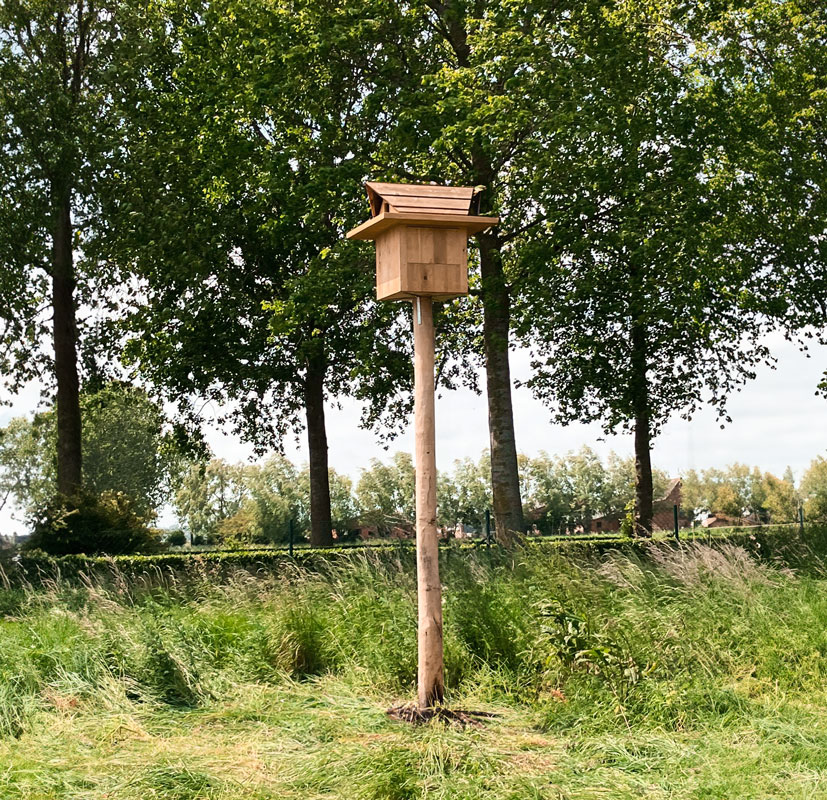
For barn owls, the nesting box must be large, deep and dry above all. Barn owl chicks only leave the nest when they are fully grown. There can be 3 to 5 young in a nest and they train their wings in the nesting box, which requires a lot of space. The height from the bottom to the access opening must be at least 45cm, which prevents owl chicks from leaving the box before they are ready. As a bottom surface, measurements are maintained around 50x50cm or 70x70cm. Owls have a silent plumage that absorbs water like a sponge, making them very vulnerable to rain or moisture. The nest and eggs must be kept dry and warm at all times.
INSTALLATION
The box is ideally hung in a tree or placed on a pole of robinia wood, at a height between 4 and 6m. Important here is that the access opening is positioned out of the wind and out of the sun (do not orient to the south). At least 1 km away from a busy road. Furthermore, there must be mice in the area. The diet of the barn owl consists of more than 90% mice. In poor mouse years, barn owls do not make a nest. They adjust their nest size to the food supply. Due to the increasing road network in Europe, traffic has become the number one cause of death. Especially in March, there is a peak when the males search for mice in roadside verges for their young. To avoid predation by martens or other animals, the lower part of the pole can be wrapped with smooth material such as aluminium. You can also extra protect the nest by placing a marten- and cat belt around the tree or pole.