
Description
For different species of mice such as the wood mouse, field mouse and shrew, a mouse rider can be very useful. It is not necessary to make the place where mice nest, but it ensures that there is always food to be found so that mice can get through the winter more easily. The riders are often deployed in the vicinity of owl and kestrel nest boxes. In winter, these birds have difficulty finding enough prey, and therefore a mouse rider can be their salvation during harsh winters. Also, buzzards, weasels, and stoats will often hunt around a mouse rider.
A mouse heap thus feeds many stomachs, it creates a larger mouse population which is then kept in check by the increase in predators.
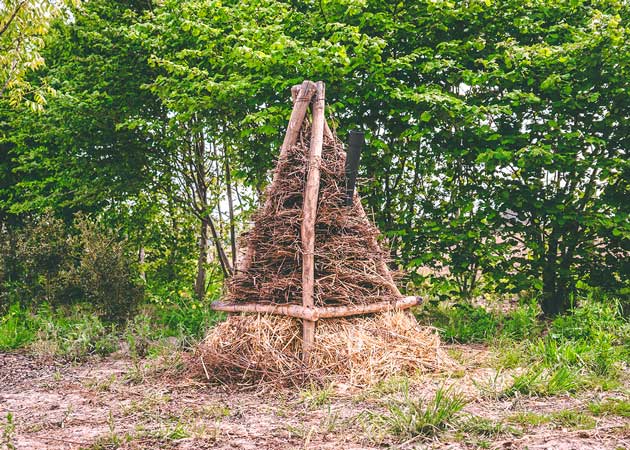
The construction is built up from poles that are placed in such a way that branches and straw can be held together inside. Halfway up the rider, a tube protrudes. The other end of this tube is located at the bottom of the rider and is used to make feeding easier.
The bottom of the mouse pyramid is at a height of about 35cm and consists of a grid on which the branches are placed. Under the grid lies straw with a lot of grain.
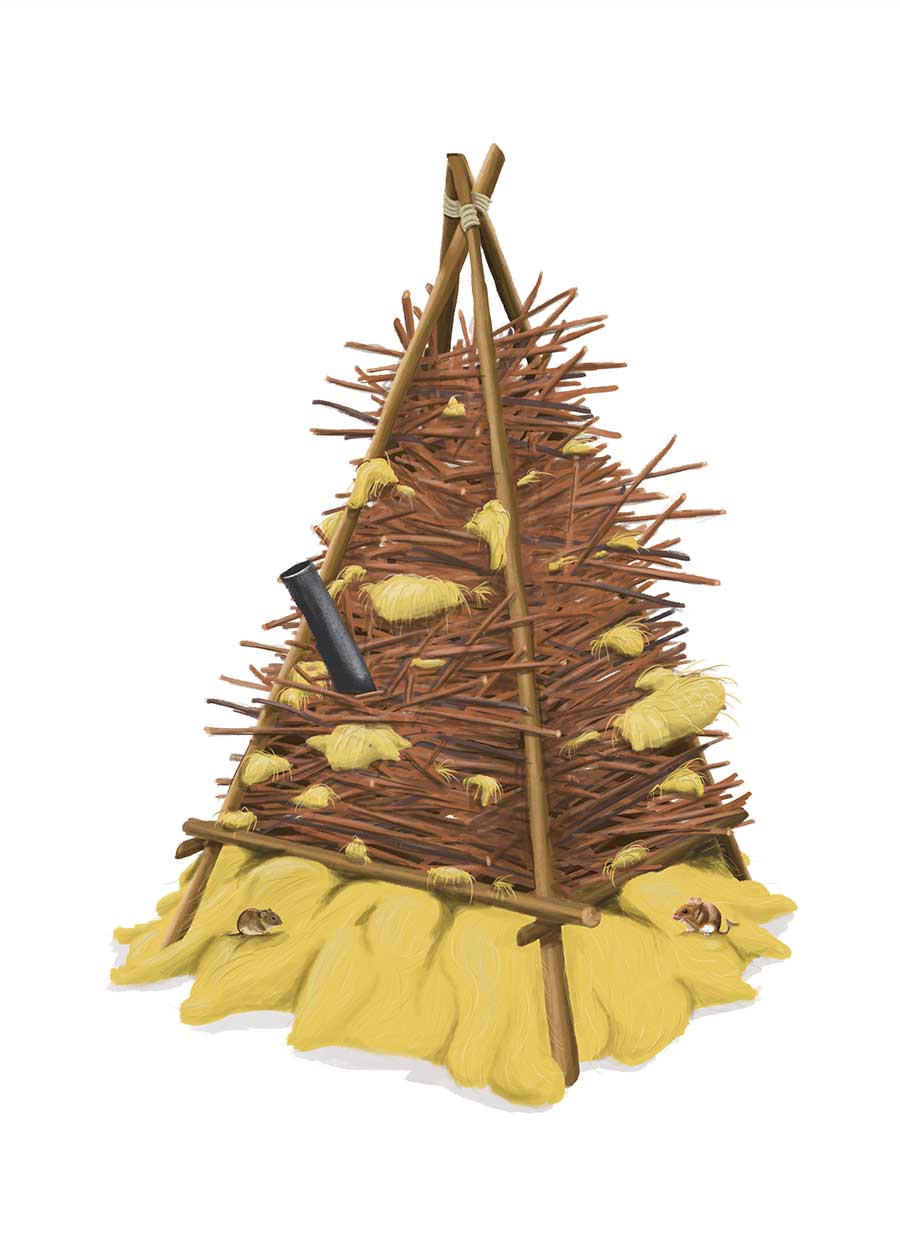
Feeding tube
Halfway up the rider, the feeding tube protrudes. The other end of this tube is located at the bottom of the rider so that it can be used to make feeding easier.
Construction
The construction is built up from poles that are placed in such a way that branches and straw can be held together inside.
Grid
The bottom of the mouse pyramid is at a height of about 35cm and consists of a grid on which the branches are placed. Under the grid lies straw with a lot of grain.